Showing posts with label Alaska. Show all posts

Thursday, March 8, 2012

Lights in the Darkness

Winter in the arctic is long and dark. Actually we are coming out of it now (only a couple of weeks left until equinox), but in exchange, we get something that you in lighter parts of the world do not:

The Aurora

in spite of the variety of colors I see in other photos, ours here are pretty much just green

but I did take these photos from my living room
unfortunately the video I froze my tooshie off to get just shows darkness...
with a lot of me whispering "they're so bright!"


There is actually another thing that lights up the dark days:

and they're even multi-colored!

Thursday, February 16, 2012

You might live in the Arctic if...

Yesterday evening Bear looked out the window at the large round thermometer we have there. He has been learning numbers at his pre-k class, and is getting pretty proficient with them.
"Oh my gosh mom!" he called to me. "Look at this! It's pointing ABOVE ZERO!"
Yes indeed my dear, it was about 18F yesterday. Then I had to explain to him that in our crazy system, it can be above zero but still below freezing. He grinned and said "It's so warm!"

the weather according to google this morning  
This morning Wolf walked home from his music lesson (the band teacher at the school sweetly offered to simply give him private lessons twice a week, since the rest of the sixth grade band has basically dropped out...it's a non-credit class and most of the kids never took it seriously). It's about a half mile walk, carrying his saxophone. As he came through the door, he proclaimed "Mom, it was so warm out there today I walked home like this most of the way," and he demonstrated, instrument case jauntily on his shoulder, jacket hanging open, no mittens, no snow pants...

And to think, just three weeks ago it was -41. (And, for my non USA readers, -40F = -40C, just for reference...)  At -41, you wear the snow pants, fleece or wool jacket, 600 fill down coat, stocking cap, coat hood, a pair of thick mittens (or two), and a scarf around your face...and your snot still freezes and you get icicles in your eyelashes.

We've passed imbolc too (which marks halfway between solstice and equinox), we have light during the day and even into the evening.


It kinda feels like springtime.

All I'm missing is flowers.

Saturday, October 1, 2011

Last Night

Thank you my little one.

I know you did not want to be awake any more than I did last night, but I also know that the time has come for you to nightwean and learn to sleep through the night, and so I was holding and rocking you as you cried, rather than just nursing you back to sleep.

And because we were awake, and because we were in the living room (due to your crying, and my desire to let everyone else sleep), I saw light outside in the sky.

And because I saw light, and because I knew what it was, I put on our coats and hats and bundled you inside my coat and took you outside.

And we walked over by the water, where we could feel the wind and smell the saltwater and hear the rolling surf and be out of the yellow glow of the streetlights.

And we looked up, in the glorious darkness of this week's new moon, and we watched the greens edged with purples of the northern lights as they danced in the sky.

photo from here, no I didn't take it, but it was taken here in Kotzebue and it is what they looked like last night

As I walked home, I fell to wondering:
If the Sun shows us Father God and the Moon shows us Mother Goddess, what is the Aurora? Is it the Spirit? Everywhere and moving and bright to see if only we can free ourselves of the little earthbound lights all about us.

Sunday, September 11, 2011

Our House in Kotzebue

Part 1

(we have rearranged the living room a little since then, as you could see in my last post)

Part 2

Monday, August 29, 2011

Link Roundup

Alaska:
Orange Goo at Alaskan Village found to be Fungal Spore, Not Eggs at NPR (news story about a town not far from here...it's in our same school district).

Attachment Parenting:
Babywearing Through the Ages at 9 Davids (lots of fun babywearing pictures from all over the world and all over the timeline)

Believing "children are resiliant" may be a fantasy at Psychology Today (discussing resilience or 'surviving' as opposed to thriving, and some educated guesses as to why kids today are not doing very well...science vindicates attachment parenting yet again).

Funny:
How Harry Potter Should Have Ended (youtube video, thoroughly amusing, although only if you're familiar with the stories and movies)

Intactivism:
Intact or Circumcised: A Significant Difference in the Adult Penis by DrMomma (this post has some graphic photos, but they are very educational as well).
"If we surgically amputate the eyelids or fingernails, we will face the repercussions of making an organ that was designed to be internal, external. In order to survive this damage, the organ must adapt...it is the same with the glans of the penis..."

Kids do the Darndest Things:
Kids do the Darndest Things (I've been adding new stories to the blog...if you haven't been there in a while, go visit! also, there's a new URL)

Makin' Stuff:
5 ingredient (vanilla) ice cream recipe from allrecipes.com (and I can verify the validity of the freezing method--which does not require an ice cream maker--although I recommend stirring every 20-30 min after that first hour).

My Faith:
Hi, I'm Jenni. I'm an intellectual, granola mom, and miscarriage activist living on the Last Frontier. I'm a Mormon. (My new "I'm a Mormon" profile, which I actually submitted last spring but they take a while to get them actually up).

Fasting For the Goddess at Daughters of Mormonism (a podcast interview with a dear friend of mine, who has proposed that if we want to know more about Mother in Heaven, we should pray for answers--and she offers up the third sunday of each month as a time to join together in doing so)
 
Saying Goodbye to my LDS Home at Project Conversion (if you haven't seen this blog, it's very cool. A guy giving 12 religions a legitimate try for a month each...July was mormon month, and this is his final post with some of his conclusions about the faith)  
And I will end with a quote from this last link:
This reaction, of thanking me for just listening, is a common theme I find with all the faiths. People don’t want to argue or convince me that every other faith is wrong, they just want people to give them a chance–to listen instead of criticize or judge. It surprises me every time it happens.
Are we that bad at listening? Why are we so quick to condemn those who think differently than we do?
You know, I used to think that I was doing something unique with Project Conversion, that I might start some theological revolution, but the more I do this the more I realize that all I’m doing is listening. When my kids were babies, they cried to communicate. I can’t imagine how frustrating it must be for an infant trying to communicate and no one listens or understands. Is that what religious strife is, everyone fighting, pitching a fit because we stopped listening to one another?
“Well, I don’t understand those people. They do things differently so how can I listen or even want to?”
Here’s a suggestion: Take a year of your life and devote it to living among, listening to, and devoting yourself to those outside your current orbit of understanding. That’s right. That means turning off the talking heads on that right-wing, left-wing or no wing cable channel and learn something for yourself. Want to know what a Hindu really thinks? Ask a Hindu and then ask about ten more because they each have different ideas. Did you know it’s the same way with other faiths?


Wednesday, August 24, 2011

Earthquake!

So there was an earthquake on the east coast of the USA yesterday. My sister lives in Virginia and said it was pretty scary for her and her little ones--things fell off shelves and they had just all gathered under the dining room table when the shaking stopped. Friends of mine in Pennsylvania and New Hampshire said they felt it too. A 5.9 is a pretty good size. I remember an earthquake in Seattle 9 or 10 years ago that was about that size, and I felt it where I was in college in Ellensburg  (110 miles away). It made the lights swing and they closed several buildings on campus for several hours while they inspected them for structural damage. I remember that being unnerving.
Prior to that I remember one other earthquake. I was 13 or 14 and I was babysitting and the whole house started swaying. It scared me for a minute until I realized that it was just an earthquake... I don't remember how big it was, but there was no damage. I called my dad and he made the excellent point that aftershocks tend to be smaller than the initial quake, and I calmed down and was ok.

When we moved to Homer two years ago I learned what it means to be totally unphased by earthquakes. We had been there just a few weeks when one afternoon things started to shake. At first I thought it was our dryer, because it could get a pretty good vibration going on through the house...but the dryer wasn't running. By the time I realized it was an earthquake it was over. I hurried to the other room where my then 2-years-old Bear was playing serenely. I asked if he was ok. He said yes. I asked if he felt the shaking. He looked at me like I was asking about quantum physics. Alrighty then!
Over the next few months I learned that we would get earthquakes several times a week--sometimes several times a day--and that every 6-8 weeks one would be a 3 or 4 or 5 and I would feel it. I learned how to guess at how big they were (and I got fairly good too--I'd put my guess on my facebook, and then ten minutes later go look it up, and I was usually within 0.2 or so!) I also learned that familiarity breeds contempt, or, at least, apathy, because not one of my kids has ever seemed the least bit phased by all these earthquakes. And, I confess, at this point, neither am I. If nothing even falls off a shelf, well, I just hop on facebook and make my prediction...
Of course, here in Kotzebue we are off the ring of fire (for the first time in my life I live in a non-earthquake zone!), so perhaps I'll re-sensitize to them. Who knows. Here I think we are probably more likely to see a polar bear in downtown than to feel an earthquake. (I'll be sure to let you know if that happens.)

But back to the Virginia quake, KSL News (in Utah) made sure to let us all know that four spires broke off the top of the Mormon temple.
AND, in case you haven't heard yet, there are some conflicting opinions about the causes of the shaking...
It has been determined that the epicenter of the Va earthquake was in a graveyard just outside of DC. The cause appears to be all of our Founding Fathers rolling over in their graves.


The President has just confirmed that the DC earthquake yesterday occurred on a rare and obscure fault-line, apparently known as "Bush's Fault."

Michelle Bachmann has promised to keep future quakes at 2.9.

The president wanted it to be a 3.6, but the Republicans said it needed to be a 6.0, so they compromised.
It wasn't an earthquake. It was a 14.6 Trillion dollar check bouncing.

...got any more for me?

Thursday, August 11, 2011

Pictures from Kotzebue

As the plane landed in Kotzebue, I was watching out the window, and I saw fields of this beautiful reddish-tassled grass. This grass seems to grow almost anywhere it can find the space to, including little spots all over town. This is just outside our house.

The tassels are very soft, and they flutter in the breeze...I had no idea what they were but a friend saw the picture and helped me figure it out. We're pretty sure that it's foxtail barley. It is stunning, really.

So here is our house. It's the white one behind all the pallets--that's our door right there in the center of the photo (just right of the green thing).
The pallets are what we'll be burning for firewood this winter. They are readily available in summertime (when a lot of things get shipped in), but harder to find in winter, when everyone wants them for their wood stoves... so our landlord collects them all summer (he lives next to us). We've been helping with the collecting--in fact today Hubby and the landlord built a woodshed to store the cut-to-stove-sized wood in--so we'll be able to use the wood as well. It's a good thing, since this is the arctic!

For the first few days we couldn't really move in because of carpet cleaning (which included a broken machine and three days of wet carpets) So even though all our stuff was in the house, this is what it looked like...

In spite of the rough start with moving in, we really like our little house. It's older, but it's clean, has fresh paint, and is very comfortable. I have a gas stove for the first time in my life so I'm adjusting to that (everything cooks faster than I'm used to, so I'm having to adapt all my baking to compensate!).We have nice neighbors--not just the landlord, but another couple and a single lady. And our 60lb dog is the little doggie on the block! Everyone (except the landlord) works at the school AND has a dog. One of the dogs looks almost exactly like Koira, only half again as big. I'll have to get pictures of them together, it's quite amusing as we have already confused them a couple of times, and we've only had them together for two days!

 
Here you can see how far we have to go to get to church (no more phone church!)
The green arrow is our house, the black arrow is the church. Between us there is a mobile home (our neighbor). That's it. It takes almost an entire minute to get to church. It'll take a little longer after it snows if we have to walk around the block.


And this photo is from the corner of the church...looking at the ocean...the ARCTIC ocean...

(You can see in this photo as well as the first one that most of the buildings here in Kotzebue are up off the ground. Apparently this is because of the wind. With the space under buildings, snow is able to just blow through, whereas if they were on the ground then the wind would cause huge drifts against the houses. I remember having to dig our way out from the front door a few times in Pelican, so I appreciate the foresight of whoever built our house putting it on stilts!)


And here are some photos from a little walk I took with Eagle and the doggie the day after we got here...

I don't know what these little white flowers are, but they're pretty. (you can click on the photo to see them larger, perhaps someone can identify them for me?)


an iris, nearly laying down, but clinging to life outside the church. I suppose it was cultivated once, but it doesn't seem to be anymore...

...and the Alaskan classic, fireweed. It's absolutely everywhere, only here it's shorter and smaller than in the more southerly parts of the state

Thursday, February 24, 2011

The Spell of Alaska

Ok, so actually the poem is called "The Spell of the Yukon" but it still applies.  It's by Robert Service. I first heard it when my dad recited it to me...I remember first being aghast that he was reciting a poem with "God" and "damned," (though he reminds me that he always substituted "darned") but my next thought--the one that lingered, was "I want to see that land!" So I guess my path to Alaska started even before mom read me Tisha...it started with Dad and Robert Service.


I wanted the gold, and I sought it;
I scrabbled and mucked like a slave.
Was it famine or scurvy—I fought it;
I hurled my youth into a grave.
I wanted the gold, and I got it—
Came out with a fortune last fall,—
Yet somehow life’s not what I thought it,
And somehow the gold isn’t all.


No! There’s the land. (Have you seen it?)
It’s the cussedest land that I know,
From the big, dizzy mountains that screen it
To the deep, deathlike valleys below.
Some say God was tired when He made it;
Some say it’s a fine land to shun;
Maybe; but there’s some as would trade it
For no land on earth—and I’m one.


You come to get rich (damned good reason);
You feel like an exile at first;
You hate it like hell for a season,
And then you are worse than the worst.
It grips you like some kinds of sinning;
It twists you from foe to a friend;
It seems it’s been since the beginning;
It seems it will be to the end.


I’ve stood in some mighty-mouthed hollow
That’s plumb-full of hush to the brim;
I’ve watched the big, husky sun wallow
In crimson and gold, and grow dim,
Till the moon set the pearly peaks gleaming,
And the stars tumbled out, neck and crop;
And I’ve thought that I surely was dreaming,
With the peace o’ the world piled on top.


The summer—no sweeter was ever;
The sunshiny woods all athrill;
The grayling aleap in the river,
The bighorn asleep on the hill.
The strong life that never knows harness;
The wilds where the caribou call;
The freshness, the freedom, the farness—
O God! how I’m stuck on it all.


The winter! the brightness that blinds you,
The white land locked tight as a drum,
The cold fear that follows and finds you,
The silence that bludgeons you dumb.
The snows that are older than history,
The woods where the weird shadows slant;
The stillness, the moonlight, the mystery,
I’ve bade ’em good-by—but I can’t.


There’s a land where the mountains are nameless,
And the rivers all run God knows where;
There are lives that are erring and aimless,
And deaths that just hang by a hair;
There are hardships that nobody reckons;
There are valleys unpeopled and still;
There’s a land—oh, it beckons and beckons,
And I want to go back—and I will.


They’re making my money diminish;
I’m sick of the taste of champagne.
Thank God! when I’m skinned to a finish
I’ll pike to the Yukon again.
I’ll fight—and you bet it’s no sham-fight;
It’s hell!—but I’ve been there before;
And it’s better than this by a damsite—
So me for the Yukon once more.


There’s gold, and it’s haunting and haunting;
It’s luring me on as of old;
Yet it isn’t the gold that I’m wanting
So much as just finding the gold.
It’s the great, big, broad land ’way up yonder,
It’s the forests where silence has lease;
It’s the beauty that thrills me with wonder,
It’s the stillness that fills me with peace.

Wednesday, February 23, 2011

30 Days--Day 4

Day 04 - A picture of your night.

Oh that's too easy!
Must
Love
Midnight
Sun!
(sorry, had to do two...)

11pm baby
moonrise (in the twilight...also around 11pm)

Monday, January 31, 2011

Arctic Homestead

When I was growing up, my mother always started off our homeschool day by reading to us. She read us biographies and historical fiction mostly, counting it toward our history studies. I think I was 8 or 9 when she read Tisha to us. It was about a young woman who took a job teaching school in rural Alaska in the early 1900s.
I was fascinated.
I guess that was really the beginning for me, of wanting to come to Alaska. I re-read the book a couple of times in my teenage years too. As I was finishing college, I was contemplating getting dual certification (Alaska and my then-homestate of Washington have a reciprocal certification agreement) and I was going to come teach for a year or two in the middle of nowhere in Alaska, save up my money, and then go back south and get married. I was going to do what Tisha did...only Tisha found a spouse up in Alaska and stayed...and, well, if that happened that was ok too.
Only I found a spouse before I got a chance to go to Alaska and get rich. So I stayed poor and got married, and I'm not sure whether Alaska was still on my radar or not...I certainly wasn't thinking about it in any concrete way. But less than 4 years into our marriage we had an opportunity to move our family to Alaska, and even though we had never made serious plans to do so, we both jumped at the opportunity. Sometimes, something is so in your blood that you don't have to talk about it. I hadn't realized that my husband felt the call of the wild too, but he did, and we came.
And when we got here, we realized that it was home.

In the early part of our marriage, we had talked about buying a little piece of land where we could have a big garden, some fruit trees, and maybe raise some chickens or something. Now that we have realized that Alaska is home--more particularly that this region is where we want to stay for the long term (employment permitting)--now we have begun researching what exactly will be involved in creating an independent, sustainable, mostly-off-grid homestead for our family in this area. We've been getting books from the library, and reading up on everything from yurts and earthbag homes to cob houses and underground dwellings. We're learning about building with logs and how to use passive solar. We plan on heating with wood and geothermal energy, and will probably have a sod roof. We're reading about wind and hydropower. We know we'll need to build a greenhouse for our fruit trees and some of our vegetables. We're studying up on breeds of chickens and sheep to find which ones are gentle with children, which ones are hearty in cold weather, and which ones are the best for eating (and eggs, and wool...) The more we talk about it, the more excited we become. We know we need to sell our house down south before we can buy land here, and we don't want to buy land until we have tenure with a school district, so as to avoid what happened last time we bought a house (getting laid off and not being able to find another job within commuting distance of the place we owned!) So this is a 5 year plan at least...but it is a plan, and we are doing our reading, and it's exciting every time we talk about it.
Lots of people talk about things, but if the last few years are anything to go by, we are not just talkers, we are doers. We are the people who hold hands, hold our breath, and just jump already.

Recently, a fellow Alaskan friend recommended the book Arctic Homestead by Norma Cobb. She was another jumper. She and her husband took their five small children and settled in the wilderness north of Fairbanks in the 1970s. I admit I am not that daring, I have no desire to be that far north. I'll stay on my very sub-arctic peninsula thank you...but reading her story was inspiring, and reminded me of the reasons why I want to live off the land, with the land, in the land...and why I want to do it here. (It was also a thoroughly delightful read, so whether you have a homesteader's mindset or not I recommend the book!)


I conclude with a post from the book that seems to capture the way I feel about living in Alaska.

"There was breathtaking beauty in the howling of the wolves, the glisten and sparkle of new snow beneath lights, the splendid aurora borealis that never failed to fill me with wonder. It was as though God hung the great curtains of fire to fill space with myriad colors of dancing forms and vast spears and shafts of light flashing from one horizon to the next in a dazzling display of His power and majesty."

Thursday, January 27, 2011

Getting the Mail in Alaska in Wintertime

  1. Decide that you want the mail more than you want to stay warm. (Sometimes it takes two or three days to reach this decision--but if I know there's a netflix out there, or we're expecting a package from someone, I usually buck up and go for it.)
  2. Collect all the appropriate paraphernalia: coat, boots, mittens, hat, mailbox key, lighter...
  3. Put mailbox key in armpit (inside coat). This is optional, but it will most likely speed things up later on.
  4. Zip up, mittens on, venture forth...the mailboxes are one driveway over. Don't drop that key out of your armpit on the way m'kay? If you do it will be a booger to find, cuz remember it's dark 3/4 of the day, and little keys don't show up very well in snow...
  5. Once at the mailboxes, light the lighter, using your body to shield the flame from the wind, and hold the flame on the mailbox lock until it gets really frosty, and then gets all wet, and then the water runs out of it... this may take anywhere from 30-90 seconds. Once the water is running then the lock is probably thawed enough to get the key in.
  6. Retrieve the key from your armpit (it stays much warmer there than it would have in your pocket, sparing you a key-heating step, which is good, because holding the flame on the key makes it vulnerable to bending or breaking, not that I would know...)
  7. Put the key in the lock. If you can. You may need to reapply the lighter, or you may need to push the key really really hard. Or both. Try not to bend the key, it doesn't work after you do that.
  8. Turn the key. This is actually the hardest part of the whole process, as the mailbox keys are cheap little things...
  9. Retrieve mail, close box, and turn key straight again. (OK, I may have lied, that may be the hardest part.)
  10. Retrieve key. If you can. Muahahahaaaaaaaa!!!
  11. Hurry home, go through your mail, ask yourself why you live in Alaska. Then  hang up your coat, put away your boots, put on some tea, and remind yourself why you live in Alaska.


Of course, when the temperature rises to around 40 then all of this is no longer necessary...we get the mail daily in those spells!

Wednesday, September 1, 2010

Razor Clams

A couple of weeks ago we had a nice low tide, so we went clamming.

What the photos don't reveal is that this walk across the 'beach' is actually walking through an inch or two of water...the whole way...
Oh, wait, that doesn't give an idea of how far out it really was.
Let's try without the zoom:
(yes, they are out there, right in the center...you can kinda see Wolf's red coat and that big rock they were next to...)

So I took the littles back off the beach and we played by the river mouth instead.

Bear threw rocks at the water (he didn't want to walk on the wet sand, preferring to stay on the dry rocks, so he wouldn't get close enough to the water to actually throw rocks IN the water...so he just threw them AT the water).
Eagle chewed on rocks and got dirty.
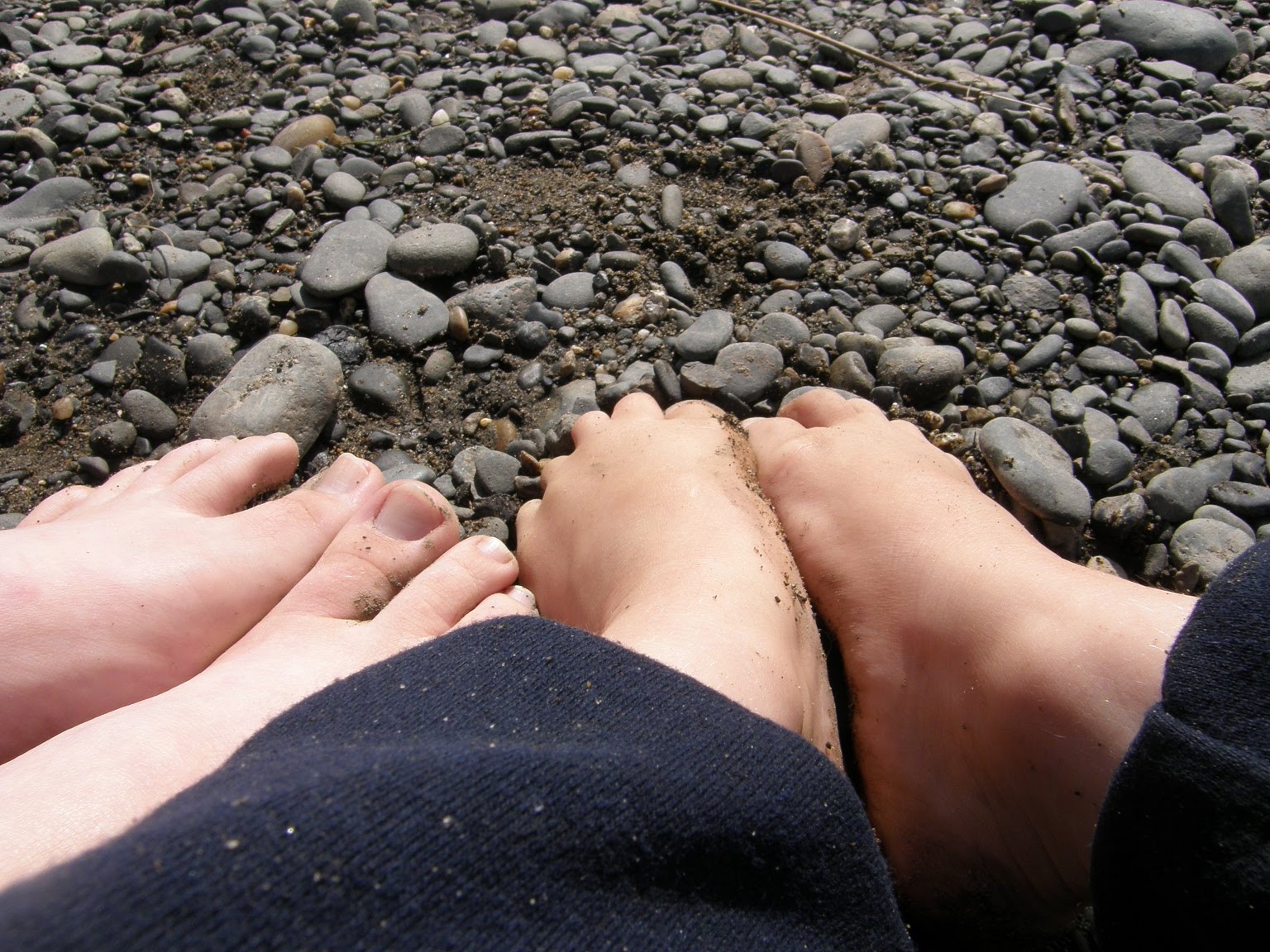
I got my toes into the earth... Ahhhhhh... (Bear is a hardcore barefooter, and since my shoes were wet from crossing the beach I joined him.)

And Wolf and Hubby dug us a bunch of razor clams. (Which, if you want to eat razor clams, you boil then for 10 seconds then drop them in ice water--that opens them up and also kills them pretty humanely--it's better than trying to cut them up without boiling them!)


For the record, I didn't like clams before, and now that I've gutted and carved a few dozen clams, I have no intention of ever eating one again. (Did you know they poop through their foot?!) Hubby and Wolf can have them all. But I guess that's ok, because they caught them.

Monday, August 30, 2010

Thank You Sockeye

I have said before that I believe in sustainable eating--in only taking what we can (will) use, and then in using all the parts of the animal (or, in making sure that all the parts are used, even if we don't use them all personally). I also believe in conscientious eating--that is to say, I believe in being grateful not just to the Lord for providing the food, but also to the animal who gave his life for our sustenance. Ancient tribes would give verbal thanks to the animal when they killed it, and I think that is a tradition worth remembering.
While I have not been present for the actual deaths of the 27 sockeye (red) and 2 pink salmon that Hubby has brought home this summer, I have done some of the cleaning and most of the filleting. I have tried to treat each fish with respect. To observe their beauty, to cut them carefully and not waste any meat. The guts and heads and other parts we don't use we try to either throw into the river at the time they are caught, or use for bait or throw back to the river or sea later on. We smoke or freeze the meat with the skin on, but since we don't eat most of the skin (Wolf likes to eat it sometimes), we give that to our dog. As I said, we try to respect the animal, and to waste no part of the life he gave to us.
I asked Hubby to take some pictures of a particularly big and beautiful fish so that I could document this side of our lives.
Look how big this guy is! Wash him off (Hubby guts them on site when he catches them).


Isn't he beautiful? I mean, he's a fish, and yeah he's a little slimy, but the colors on their heads and backs are so beautiful.
Take off the head, right behind the first fin (cutting as close to the fin as possible, so as not to waste meat). I find it hard to make that first cut--probably because that eye is looking back at me. But taking off the head (pardon the expression) dehumanizes the fish enough that I can do the rest. It is HARD for me to slice these guys open. Hard to think that we took a life. Sure, I know this was a spawning salmon and that it would have died within another week or so anyway, but still, we're responsible for his death, however slight it was in it's prematurity. That responsibility keeps me determined to use every bit of the meat.
Two very fat salmon fillets. As I'm taking the meat off the bones I often end up with little bits that didn't slice nicely--little scraps and bits. (I had a lot of those bits at first, I don't make so many now.) I collect all those together as well, and when I have a couple of cups I chop them up and use them to make salmon burgers or quiche or something like that.
I took a life to sustain my own; I must not waste it.

Wednesday, July 28, 2010

What it's like to live in Alaska--part 4

Part 1: Introduction
Part 2: Things people always ask about
Part 3: To love, or not to love
Part 4: Local Foods


"I would love to know about the gardening in Alaska, local food production, any farmers markets type things going that you have experienced."

I admit that after living 25 years in the lower 48, my first thought was "my gosh they won't have anything up here except fish," but actually that is not true at all.

Yes, we have fish. We have LOTS of fish. Halibut, salmon (all types), cod, sablefish, herring, etc etc. We also have lots of other seafood: multiple types of crab, multiple types of clam, mussels, scallops, and shrimp. Plus some folks like to eat the salmon roe (eggs) and milt (sperm--yes, they eat the fish sperm, apparently traditionally it's a delicacy. Eww!). I eat fish, I don't eat the other sea stuff. I think it's vile. But it's popular.

We also have moose, deer, elk, caribou, bighorned sheep, mountain goats, black bear, buffalo, and assorted birds, all of which are good eating. (It's also legal to hunt grizzley bears, wolves, and wolverines, but that's more about fur than meat...and in spite of it being pretty sustainable up here, I don't believe in wasting parts of the animal, so we only hunt for meat.)

So there is that whole side of local food...but I think Aimee was curious more about the plants and things.

On the wild side, we have berries everywhere. Blueberries, strawberries, raspberries, lowbush cranberries (not the bog type), thimbleberries, salmonberries, huckleberries, elderberries, and crowberries all grow wild, and most can be found without too much effort. There are also some edible flowers--fireweed jelly (which is made with a combination of fireweed and clover) is a popular Alaskan product--something tourists buy alongside their antler jewelry and smoked salmon. I confess I really want to make it at least once, but I hear it's a royal hassle, so I suspect I won't do it regularly.

In regard to cultivated foods, it's easy to think that we can't grow much because we have a short growing season. This is true, we usually can't plant outside until May or June, and start having frosts in September, BUT in those few short months, we do have more than 20 hours of sunlight per day...so it really depends on the plant. Some plants need a certain number of days to grow, others only need a certain amount of light...obviously the latter sort do great here.
Many people have berry patches, since those grow so well here naturally. Rhubarb is also very very common--it grows easily and quickly and everybody who has a patch always seems to be willing to give it away.
All the root vegetables--potatoes, onions, garlic, rutabegas, carrots, parsnips, beets, turnips, and radishes thrive, and since most of them can take the frost (and some can even keep through snow and hard freezes), it's safe to keep them in the ground into the autumn.
Broccoli, cauliflower, brussels sprouts, lettuce, cabbage, and swiss chard all do well here too. Most gardeners will start the plants indoors, or plant them as seedlings rather than seeds, so they can get a head start on the short season.
If you want tomatoes or peppers, you'd better build a greenhouse or fit them inside your house (I have tomatoes in pots taking over my kitchen, but they are producing well!)

(this logo is available on clothing;
I want to get matching shirts for all the boys)

I have actually been working on adapting our eating habits to reflect the foods that are available locally. Yes, at least at present, we are still buying some avacados and bananas, but I'm learning to use more rhubarb and berries and fewer peaches. There are lots of things that are grown here in greenhouses, so we buy alaska grown as often as possible.

Friday, July 23, 2010

What it's like to live in Alaska--part 3

Part 1: Introduction
Part 2: Things people always ask about
Part 3: To love, or not to love
Part 4: Local Foods

"What do you like most about Alaska?"
The wildness, the closeness to nature, the freedom of living on the frontier...
I also love the 'come as you are' acceptance of people. The freedom to walk to my own beat because everyone else is walking to theirs.
And if you're not into that, one thing that everyone agrees is a perk here is the PFDs--permanent fund dividends. It's the oil money and once you are a permanent resident (have been here more than a calendar year) then each year you can file for a PFD for each family member (so we get 5 this year) and they tend to be over $1000. Last year it was $1305, the couple of years before that were closer to $1600...it varies year to year because it's based on invested oil money and how much was earned in the year divided by how many people are getting it... Anyway, we are currently using ours to pay off debt, but in a couple of years we'll start socking it away to pay for missions for our 3 sons. ☺


"What do you like least?"
Traveling is expensive--it's $500 round trip to fly to Seattle, and more to anywhere else... Driving is about 2500 miles to the northern border of the lower 48, and if you push you can do it in about a week. Gas in northern canada is really expensive (think $6+/gal) so driving is cheaper than flying if you have a family, but it has expenses of its own... We decided that we will go down and see family every other year, and that's just how it goes. So that's a hard thing--not seeing family. We call and email and such a lot, but we don't get to see them very often because it is just so cost prohibitive both in time and money.
Traveling in-state isn't cheap either--if you're in Juneau, a flight to Anchorage is about the same price (and same distance) as a flight to Seattle. It's 8 hours of driving from Anchorage to Fairbanks, and that's only halfway up the state (although not a whole lot of people bother to go north of Fairbanks unless they work there).
The other thing frustrated me in the bush (though not so much here), and that was that it took forever to get things or to get things done. For example, we ordered internet...that was fine, but they had to mail out the satellite dish, then we had to find someone to install it...it took two months to get it up and running. And when we had technical trouble we'd better hope it wasn't fishing season or the one guy in town who did that stuff wouldn't be able to come fix it for over a month... We'd order something online and they'll assure us that we'll have it "in two days" and "delivered right to our door." Sure we will. It will be over a week and I'll have to go get it from the seaplane office or post office. Never order perishable anything!! Even when my mom mails me a package, the postal worker there will tell her "it should be there in 5 to 7 days" and I get it two and a half weeks later. Just realize that things take longer to get here, and then you can be pleasantly surprised if they don't, but you won't be frustrated when they do!

Tuesday, July 20, 2010

What it's like to live in Alaska--part 2

Part 1: Introduction
Part 2: Things people always ask about (today)
Part 3: To love, or not to love
Part 4: Local Foods

"Isn't it dark all the time?" (or, occasionally, "tell me about that midnight sun thing")
3am, early June, near Tok
 Ahh the light! The light is both a pro and a con in my opinion. In the winter, here in the southern part of the state, there's only 5ish hours of light, (Fairbanks has 3) so you wake up in the dark and go to bed in the dark and eat dinner in the dark...however it really only lasts a couple of weeks (the light changes by about 5 min a day, so that's 35min/wk, so it goes but then comes again very quickly). In the summertime, right now near solstice, we only have a couple of hours of dark. The sun is set for about 5 hours, but it never really gets darker than twilight. Having it so light can make it hard to get the kids to bed in the evenings (good curtains are essential),
sunset, 11pm, late June, Kenai Peninsula
it also means that the evening escapes from you...my husband is a teacher so we don't have a work schedule in the summer to regulate our days...so I'll start thinking hmm, I should work on dinner, and I glance at the clock and realize it's hours past our normal dinner time. It's just so light that it's energizing and I lose all track of time. Also, on the nights that I neglect to shut our blinds (because we often stay up until it's getting darker), the baby gets wakened by the bright sunlight streaming in at 5am...so yeah, curtains are very important. ☺
It's ironic I suppose, because we do love the light in the summer, but it actually has required more adjustment for me than the winter darkness... In the wintertime there are so many other things going on (holiday gatherings and such) that I am busy and don't notice so much...by January when the social events peter out, the light is already on its way back. That summer light though, well, let's just say I've been sleep deprived for two months and the end is not yet in sight.

"Is the climate seriously that mild?"
The climate varies a lot from one area to another--remember that from Juneau to Fairbanks is about as far as from Texas to Minnesota... So the climate I talked about was what I have experienced here in the southern part of the state and in "southeast" (the islands in the Juneau/Pelican region). In Fairbanks (which is only halfway up the state) they get temperatures of -40 (yes folks, that's Fahrenheit, so it's actually 72degrees below zero). They are inland, without the moderating effects of the sea which we have (and had in Pelican too). In the summertime they get temperatures up to 80+, which we don't really here. The other day we went to the Farmers Market and as I was buckling the kids into the car I thought wow, this is a nice warm sunny day...on the way to market I heard the temperature on the radio: 59.
I should note that I've always been a person who tended to be a little cold, BUT I would rather be cold than hot. When you are cold, you can always put on some socks or a sweater; but when you are hot there is a point at which you cannot take off anything else...I am very content to be in a place where 80 is flippin hot and doesn't happen very often. I find that people acclimatize (so long as they are not mentally refusing to do so), and so while 59 would probably have been jacket weather in Utah, here we are in our t-shirts and sandals enjoying the sunshine.

"Isn't Alaska really expensive?"
The cost of living here varies by where you live--life in the bush is extremely expensive because everything has to be shipped out. In the more developed areas (on the roads) it's actually about average for the country, although that's still higher than most non-metropolitan regions down south. Salaries usually compensate for that, but many (many) families feel the need to have two or three or four incomes (as in, both parents work, each of them with a couple of jobs). A LOT of work here is seasonal with fishing and things like that, which I think is part of the reason. Whether you can get by one one income or not really depends on your lifestyle and how you budget and your feelings on wants vs needs. Heating bills can be pretty high in the winter. We live pretty simply, and frankly there are times when I really wish for some extra money, but we are getting by.

"I hear the hunting and fishing is awesome"
Yes, it is. ☺
Some love it for the sport, I love it for the whole "eating local" and "living off the land" thing. I actually don't like salmon very much and would never buy it, but when you can stand in the river and catch them just standing there with a net, yeah, not gonna turn down nearly-free fish. A combination hunting/fishing license for a resident is $50 (non-residents pay a lot more--Alaska is smart like that, knowing the the locals rely on wild meat for food, but the tourists could afford to travel up here so logically they can afford an expensive license too!). My husband has caught a couple dozen salmon in the last few weekends and our freezer is filling up. He's going to go out after halibut (which I do like), and hopefully this fall he'll get a moose, which is about 700lbs of meat. The wild berrying is good too. There is just a lot of bounty from the land, and few enough people that we can all harvest from it all that our families need. There is something deeply satisfying about providing for your family with your bare hands, you know?

"I'm wondering if you have any ideas about what someone might prefer to bring with them, on a move to AK, if they have to fly it or ship it by boat (no roads to where they're moving)?"
If you're moving to the bush (off-roads) then it's going to be more expensive than anywhere on the roads. If you're heading for southeast then you can take stuff on the ferry--the general policy there is that you have to haul your own stuff on and off the boat, but you can bring about as much as you want. If you're heading for the Aleutians, I know there are barges and I think there are ferries, but I admit I don't know the policies. If you were in the inland bush--where all transport is on tiny planes--then it's going to cost a fortune and there's no way around it. Freight on the seaplane in Pelican was by the pound, and it was $1/lb for whatever you wanted to bring on besides yourself and 50lbs of luggage. Those little plains can only hold about 1200 lbs (depending on the plane of course), so they weigh everything that goes on board (even the pilot) and add it up to determine what can go on this trip and what has to wait.
I can tell you what we did: we got rid of most of our things--definitely anything large--and replaced it up here. When we were in Pelican we were in a partially furnished apartment (which I believe is fairly common in bush areas, since it's so expensive to get things in and out) so you should definitely check on that before deciding what to bring. When we moved back out to the roads we brought what we could by ferry and road, and then everything else was sold down south and replaced up here. That actually was cheaper than renting a truck down south and bringing everything up... (the truck was over $1000 for a week, and gas would have been probably $3000+).
If you are going to be going into a furnished apartment, then all you'll need is clothing, toys, personal items, and maybe some kitchen stuff or linens. That was what we had, and we just flew with it, paying the extra $50/box on the jet when we flew. (A short recap of our trip is here.) That trip--after our airline tickets--was about $700 in moving costs. We moved a family of 4 (plus a dog) in 20 boxes/suitcases.
When we moved from Pelican to here, we packed what we could into our van, and the rest we mailed to ourselves (or, rather, to a friend in Anchorage who held them for us until we got there). Yes, we moved mostly via mail--35 boxes mailed to ourselves. That cost for all the mailed boxes was under $400 if I recall correctly (and the ferry charges for the family and vehicle we would have paid anyway, so I don't see them as moving costs per se, you know?)
I would recommend to call the ferry/barge/plane companies and tell them you're moving and ask about rates. Talk to locals in the town too--they tend to know a lot, and may be able to tell you things that you would not know to investigate yourself (like that one company offers discounts to people who are moving, or that so-and-so has a couch they'll let you have for free so you don't need to bring yours).

"Are there things that are outrageously expensive or unavailable in Alaska that we might take for granted in the lower 48?"
Fresh dairy or eggs cost a fortune in the bush--they are not produced there and cost a lot to bring in because they have to be brought in via fast methods rather than cheap ones... In Pelican milk cost about $8/gal, and the eggs were I think around $4/doz. We (like everyone else) used a lot of powdered milk and eggs (very easy for baking) and reserved the fresh stuff just for eating straight. We also had a lot of the boxed milk (super ultra pasturized, not much nutritional value left I'm afraid, but it's shelf stable, and passable on cereal or in sauces where powdered didn't cut it). I also made yogurt with it.
Living in the bush requires a lot of planning ahead. In Pelican they shipped in Costco orders once a month--we all ordered together and shared some of the cost that way. Since the truck was not temperature-controlled I had to consider the weather in deciding what to order--frozen meats and veggies in February, potatoes and fruits once things warmed up a little...
The one thing that is hard to come by--at least in the bush--is fresh produce. We ate almost exclusively frozen or canned. The frozen and canned produce is 'normally' priced, but anything that can't be grown locally will have to be shipped up and of course that means it will either be very expensive or very poor (or both). I am learning to simply enjoy eating foods that grow here, and rarely buy things that do not.
Utilities can be very expensive here too--depending where you are. Heat, especially, is important of course, but depending on the source (many use oil heaters) and how far the fuel has to be brought in, it can be extremely expensive. I recommend getting a place with a wood stove if you can, and heating that way as much as possible.
Finally, shipping costs to Alaska are a pain. I use almost exclusively amazon.com and their free shipping. Everybody else tends to have the $7 AK surcharge (even if you order over $50 and get the 'free shipping' you still have to pay the surcharge). Amazon is my hero in that regard (I understand that drugstore.com does the same, though I have never ordered from them). In the cases where you can't find free shipping, or for places that simply don't ship to Alaska, get yourself a friend or family member down south. More than a few times I've had a box sent to my mother in Washington, then she mails it on to me and I reimburse her...and it's usually still cheaper than if I'd had it shipped directly to me.

"Also: you say that everyone in Alaska is quite hospitable to their neighbors (awesome!). But is there any racial tension to think about in that equation? If I am of Swedish/German heritage and were moving, say, to a town with 70% Native Alaskan ancestry, will I be truly welcomed as a new neighbor or viewed as somewhat an outsider?"
In my experience, as a German/Scandinavian myself, no, race didn't really matter. Now some villages are more heavily native than others, so that may vary--Pelican was less than half native. The native families tended to take pride in their heritage, but so long as everybody was respectful about it (and allowed them their pride) I never saw tension over it. I think the important thing is to be willing to respect them and their culture. (My Wolf went to a summer 'culture camp' in Pelican where they made traditional deerskin drums and learned dances and such, and when they asked him what clan he was from he didn't know and came home to ask me. I told him the only clan we were from was the Stewarts of Scotland--he went back and told the teacher that that was his clan, and she thought it was adorable...)
You should be aware that there are two different groups of native peoples here, and they take great offense at being confused. In the south/southeast parts are "Alaska Natives" (Tlingit, Haida, etc) and they are of similar ancestry to the tribes in British Columbia or Washington state. They fished and foraged but lived in a generally forgiving climate and had (compared to more northerly tribes) an easier life. In the more northern areas are the Inuit peoples (Athabascan, Aleut, etc) and they are genetically and culturally totally different. They are the peoples who were once called "Eskimo" and while that term is no longer considered politically correct, they have the heritage of igloos, sled dogs, and survival in sub-zero temperatures. Their ancestors were the ones who came across the land bridge from Siberia, and they do not even look the same as the peoples who migrated up from down south. One of the most offensive things you could do is to confuse the two groups of peoples...so I stick with avoiding assumptions, and treating everybody the same and not worrying about it. So far so good.
As for whether you'll be an outsider, well, that has nothing to do with race. That has everything to do with the fact that you'll be coming in from out of state. No matter how much you say you love it, everyone will nod knowingly and say "wait till you've done a winter before you decide..." It's fair enough. A lot of people like Alaskan summers, but realize they are not cut out for the winters. People who don't like Alaska only last a couple of years usually. Particularly in the little towns, you will be a newcomer for a year or two. Once you've stuck around for a couple of winters, and participated in the community events, they will accept you more. If you subsequently move within the state, you'll be already an Alaskan, and will not be an outsider anymore. (I don't think Anchorage is the same in this, since they're a suburb of Seattle rather than part of normal Alaska...but I can't say for sure since I've never lived there!)

Friday, July 16, 2010

What it's like to live in Alaska--part 1

Recently I got an email from one of my blog readers here (that's always so flattering!), asking me what it's like to live in Alaska. Her husband is considering a job here and she was trying to get a good idea of what they'd be getting into. Several readers have said that they like my Alaskana posts, and would love to read more, but I admit that I'm frequently at a loss for what else to write on the topic...however this question got me thinking, so I thought I would share here some of what I wrote back to her. ☺
I must preface this with the statement that I have never lived in one of the 'big' cities. Pelican had about 100 people in the summertime...half that in the winter. On top of being tiny, it was a bush town in that it was cut off from everything...no grocery store, no roads, ferry only once a month, seaplanes most days but only if the weather permitted... Now we live in what I consider to be a pretty perfect home, with a thriving population of about 5,000, and the nearest larger town being 90 miles away (it is a metropolis of about 30,000 people). So when I speak about what Alaska is like, I'm telling what it's like in the middle-sized places, or the little places, not in the Anchorage area. Anchorage is more like a suburb of Seattle they say. I wouldn't know. I haven't lived there; and since I love it here, I don't really plan to move.


My husband says I should tell you that living in Alaska is terrible, so that you won't come, because we like having a low population and don't need any more people. ☺
He also said "we live much closer to the wilderness, because it's everywhere, and it's such a young state [50yrs this year] that it maintains a frontiersy feel, but still has the modern amenities. It has a mild climate and is one of the most beautiful places on earth. I always wanted to live where everyone else went on vacation, and now I do." ☺

I will start off by saying that I think people either love or hate Alaska, and I think they usually know within a couple of weeks. That was my experience in any case, and my husband's, and many other people I know. I've heard so many stories of someone who decided to drive the Al-Can highway for a bit of an adventure...and when they got up here to Alaska they decided they didn't ever want to leave. I think that some people are Alaskans, regardless of where they were born, and when we get here we just feel it to our core that this is home. ☺ The people who don't like it tend to leave pretty fast. I would strongly advise visiting if you think you possibly can. I think you can get the feel from a visit of whether you would love it or hate it.

There are several parts of Alaska, and it can be vastly different depending which part you live in. Remember that this state is the size of about 5 other states!
I can't speak for the Aleutians really, nor the Fairbanks/Arctic region (although it does get extremely cold there, people have to plug their cars in to keep them warm enough to be able to start them for example...everyone in Fairbanks has a little plug hanging out their front grill). But I can speak for where I have lived.
The Southeast (Juneau, Sitka, Pelican, Ketchikan, etc) is a temperate rainforest. It rains 300" a year, Pelican usually got around 20 ft of snow (though not all at once of course). The temperatures are moderate, usually between 20-40 in winter and 50-70 in summer. It still rains in the summer though. When you've got 300 inches to get out every 365 days, you can't take too many days off.
South Central AK (Anchorage+ the Kenai Peninsula) is probably the nicest part of the state. It's not nearly as cold as the more northern parts, and not nearly as wet as the rainforest in southeast. Anchorage of course has the heaviest population density in the state, and the Kenai region is where Alaskans go on vacation.
Most people are concerned about the weather, especially the winter. Well, here in south-central we got perhaps 6ish feet of snow here last winter (spread across the months of course). We had a lot of temperatures in the 20s and 30s, during the day, and it would get colder at night of course, but not below 0 really. Honestly winter here wasn't much colder than what I remember from living in Utah. I always wore a coat and gloves when going out to the car, and usually a hat if I was going to be out for more than a minute. Winter is probably 5-6 months long, but my experience has always been that the people here are very open and hospitable, and especially in winter (because so many people have seasonal/summer work) they tend to do a lot of social things.
Spring in Alaska is extraordinary--it may take its time getting here, but when it does it is so beautiful. I grew up in western Washington so I've seen pretty wild places, but Alaska really beats all. There is SO much wild space still, and there are literally fields of wild flowers by the side of the highway within minutes of downtown anywhere.
Summer is spring x10. Summertime in Alaska is a well-kept secret I think. If more people knew, more people would come. I can take 5 months of winter to get those 2 months of summer.
It is cooler here, certainly. Average summer weather is 60-75 or so...85 is swealteringly hot. :) We tend to love it--it's one reason we live here.

Anchorage is the 'big city' and it's still only about 200k people if I recall correctly. Alaskans think it's huge but anybody from 'down south' (the lower 48) thinks Anchorage is pretty small. There is a sense of proportion here that is unlike anywhere I have ever been. The people things--the houses and cities--tend to be small. But the wild things--the mountains, animals, rivers, ocean, and sky--they are enormous. We live in a 1300 square ft apartment which admittedly can feel crowded, if only because it lacks storage space...and yet we see mountains and old growth forest from our front window and routinely see moose of over 1000lbs in our backyard. In Alaska, man is the newcomer, the visitor; the one who looks out of place.

There is a sort of "come as you are" attitude here in Alaska. Most folks aren't uptight about whether your lawn is mowed or your hair is highlighted or styled just so, and nobody really gives a second glance if you show up to church in your jeans (not that we do, but people who are traveling through sometimes do). People tend to be friendly and helpful--at least that has been my experience in the smaller towns. I don't find it quite so much in the big city... Anchorage is kindof it's own place in the middle of the state, and most any Alaskan will tell you that it's different. In the city it's a lot like living anywhere else in the country except you're farther north (and close to good hunting and fishing). The rest of the state is not like Anchorage. We're "the last frontier" and proud of it.


I have a part 2 written as well, and will post it in a few days, but if there are any things you're specifically curious about, please ask! I could ramble on about what foods grow wild here, or what I have found the easiest or hardest to adjust to, or what are my most and least favorite things here...tell me what you want to know!

Saturday, May 1, 2010

Beltane Bonfire

A local group put on a bonfire at the beach last night. Their intent was to raise awareness because April was "domestic violence and sexual assault awareness month." They spent a little while on that, but then much of the evening turned to drumming and roasting marshmallows and playing on the beach. I certainly support the group's cause (you can see in the photos some people with candles), but we also thought it was nice to spend a seasonally significant evening in nature with a bonfire. (The flames were not big for long, but it was putting out a lot of heat!)
Bear tossed a football with daddy,

and Hubby (and Wolf) got in touch with their Scottish heritage by throwing around some logs.

Thursday, February 11, 2010

Some things I ♥ about living in Alaska

  • The Permenant Fund Dividends 
  • The way that most folks here walk to their own beat
  • The way that most folks here are comfortable with everyone else walking to their own beat too
  • Many of my 'hippie' ways (such as unmedicated childbirthing) are common
  • That most everybody has a dog that's a member of the family, and therefore most hotels allow dogs
  • The government here mostly has a 'hands-off' attitude
  • The way that the rest of the country forgets we are here and leaves us alone
  • No state income tax
  • It's actually possible for a family to live on a teacher's income here
  • Awesome berries
  • Huge vegetables (thank you midnight sun!)
  • The midnight sun
  • The northern lights
  • The wintertime sunrises (which aren't until 9am so I get to see every one of them) (photo taken from my porch)
  • The way that people take care of each other
  • Knitting is a worthwhile endeavor here because we can wear our nice wool sweaters 11 months of the year
  • Living on the Last Frontier--one of those rare places that actually still has wilderness
  • The views (first photo taken from my porch again, the other an hour from here)

Wednesday, September 30, 2009

Close to Home

Now that I've showed off my residence, I thought I'd show off some of the scenery from the neighborhood... I think I mentioned before that the fireweed were in full bloom as we drove into town that first day, and while they have since wilted in the frost (it is practically winter now) they remain in my mind as part of my first sight of this area.


Yes, the hills really were covered with pink like this the whole way in. ☺

And, of course, my new banner...the view on the way into town (in the early morning light):

Linked Within

Related Posts Plugin for WordPress, Blogger...