Showing posts with label celebrations. Show all posts

Tuesday, December 4, 2012

Holidays After Loss ~ Special Ornaments

Recently The Amethyst Network has been working on renovating and updating our site and our organization. One new project we are launching is monthly blog circles, where we put up a hosting post and invite other bloggers to share their post on the same theme. This month the theme is "Holidays After a Loss."

customized with birthstone and name


During the first Christmas after my first loss, I had recently become pregnant again, and was very morning sick and honestly not thinking very much about the 3-month-old that I didn't have. One year later, with several more miscarriages behind me, I felt it much more keenly. I wanted a way to keep those babies as part of our Christmas. I remembered that my mother had been given an angel ornament after Amethyst passed away, and I decided to follow suit. Our living children each have their own special ornament, and so I began to purchase angel ornaments for each of my angel children. I have known families who purchased a new angel each year, but I just got one angel per baby (since there were several). Other families might prefer something other than angels, but the idea could still apply as a way to memorialize our little ones, and to keep them as part of our holidays.
Here you can see some of mine.
(the ball has l.e.d. lights so the angel changes color...)
Go check out TAN's hosting post here for links to other articles, or to add your own link to the circle.

Sunday, November 27, 2011

First Sunday of Advent: HOPE


Mormons don't typically celebrate Advent, but I frankly don't know why. Perhaps it was an effort to set ourselves apart from other churches (since Catholics and many Protestants do observe it). When he came home from his mission in Norway, my husband brought an advent wreath, which is a round candleholder which holds 4 candles. Our family has always lit the advent candles, one on the first sunday, two on the second, and so on until Christmas. (This year, since Christmas falls on a sunday, Advent begins earlier than usual.)

In some traditions, each week is marked with a virtue, most commonly (from what I understand) are faith, hope, love, and peace. This year, I am choosing to observe Advent with my own adaptation of that. Each week I am choosing a virtue (not necessarily the traditional ones), and during that week I will study, ponder, and strive to practice that virtue. Since I am in charge of the children's primary at church here, I am also doing our "sharing time" lesson based on the virtue of the week.

This week, the theme is HOPE.

I showed the primary kids this picture, and we talked about prophets foretelling Christ's coming, and about how believers had to have hope that He would come. We talked about us now having hope for His return.

hope
the feeling that what is wanted can be had or that events will turn out for the best
a person or thing in which expectations are centered
to look forward to with desire and reasonable confidence.
to believe, desire, or trust
to feel that something desired may happen

As I said, I'll be putting some study, pondering, meditation, and so forth in this week. Theoretically I will write something about my thoughts in a few days. But for now, I invite you to join me in celebrating Advent.

Saturday, November 5, 2011

Our Samhain

One of the things I love about living in Alaska is the wild meat we're able to hunt and butcher ourselves. It was actually on Mabon that we got a call from a neighbor who had some caribou they had shot but could not fit it all in their freezer, and they asked if we wanted some. So we spent our Mabon evening butchering and freezing caribou.
Since Samhain is a time of giving thanks for the harvest of meat (and showing gratitude for the animals' gift of their lives for our sustenance), I thought it was appropriate to eat some of our caribou tonight.
We had actually had a caribou roast just a few days ago, so instead of cooking another one, I chopped up the leftover meat, added in carrots, potatoes, broccoli, and peas, and poured over the leftover gravy to make a savory caribou pie.

Samhain is also a time to ponder on death, and to remember our loved ones or others who have died. I had planned to make "dead bread" but we had a last minute shuffle (something came up and with very little notice we ended up celebrating a night earlier than planned), so that fell through and it was just the pie.

The boys drawing their pictures
you can see our element candles and the remainder of the caribou pie...
However, we did do something to remember our departed loved ones, and that was to write messages or draw pictures for them, and put them in the fire so that the smoke could carry our love and thoughts to them. My husband wrote to his granddad who passed away this last year. I wrote to my babies who died before I was ever able to meet them. My sons all drew pictures.

Thursday, September 22, 2011

Celebrating Autumnal Equinox


Background:
Mabon is the second of the three harvest festivals. Lammas celebrates grains, berries, and other early foods. Samhain celebrates the meat harvest of hunting and slaughter time.

Mabon was not an authentic ancient festival either in name or date. The autumn equinox was not celebrated in Celtic countries, while all that is known about Anglo-Saxon customs of that time was that September was known as haleg-monath or 'holy month'. The name Mabon has only been applied to the neopagan festival of the autumn equinox very recently; the term was invented by Aidan Kelly in the 1970s as part of a religious studies project. Previously the festival was simply known as the 'Autumnal Equinox', and many neopagans still refer to it as such.
The name Mabon was chosen to impart a more authentic-sounding "Celtic" feel to the event, since all the other festivals either had names deriving from genuine tradition, or had had names grafted on to them. The use of the name Mabon is much more prevalent in America than Britain, where many neopagans are scornfully dismissive of it as a blatantly inauthentic practice. The Druids call this celebration, Mea'n Fo'mhair, and honor the The Green Man, the God of the Forest, by offering libations to trees. Offerings of ciders, wines, herbs and fertilizer are appropriate at this time. Wiccans celebrate the aging Goddess as she passes from Mother to Crone, and her consort the God as he prepares for death and re-birth.
Various other names for this Lesser Wiccan Sabbat are The Second Harvest Festival, Wine Harvest, Feast of Avalon, Equinozio di Autunno (Strega), Alben Elfed (Caledonii), or Cornucopia. The Teutonic name, Winter Finding, spans a period of time from the Sabbat to Oct. 15th, Winter's Night, which is the Norse New Year. [source link]


Also called Harvest Home, this holiday is a ritual of thanksgiving for the fruits of the Earth and a recognition of the need to share them to secure the blessings of the Goddess and God during the winter months.

This time of year also coincides with Michaelmas (Sep 29), which celebrates the Archangel Michael's victory over the Dragon (the devil). For more on that, visit Ayla's neat posts from last year: part one, part two, and the dragon hunt!


Symbols:
  • red, orange, rust, brown, maroon
  • apples, nuts, squash, gourds, pomegranates
  • pinecones
  • vines (grapes, ivy, etc)
  • corn stalks

Symbolism:
  • Gratitude for the harvest
  • Gratitude for everything else
  • Balance (the balance between light and dark, also between life and death as plants are giving fruit at the same time they are dying. It is appropriate to recognize all forms of balance at this time.)
  • Harmony
  • Self-reliance 
  • Wisdom 
  • Old age (including the transition from "mother" to "crone/wisewoman," or from midlife into old age)(here is a great site about the crone archetype)


Activities:
  • Sing songs of thanksgiving and harvest home (see below)
  • Pick apples
  • Dry apples to make little wrinkly 'faces' and then add corn husk bodies to make little harvest people
  • Write down things you are thankful for on little pieces of paper. Read each one aloud, and put it into the fire to let the smoke carry your gratitude heavenward.
  • Make cider, juice, or wine
  • Make applesauce
  • Gather seeds from dying plants to use for next year 
  • Gather nuts
  • Gather herbs and dry them
  • Make grapevine wreaths (or buy grapevine wreaths and decorate them)

Come, ye thankful people, come, raise the song of harvest home;
All is safely gathered in, ere the winter storms begin.
God our Maker doth provide for our wants to be supplied;
Come to God’s own temple, come, raise the song of harvest home.
 
All the world is God’s own field, fruit unto His praise to yield;
Wheat and tares together sown unto joy or sorrow grown.
First the blade and then the ear, then the full corn shall appear;
Lord of harvest, grant that we wholesome grain and pure may be.

(You can hear the hymn here.)


Food:
  • Have a lavish feast!
  • Apples
  • Apple cider (there is a recipe to make your own here)
  • Apple pie
  • Squash
  • Beans 
  • All vegetables that are in season, including root vegetables like potatoes, carrots, and onions
  • Grapes & wine
  • Nuts and nut breads

Resources:

Tuesday, August 2, 2011

Celebrating Lammas


Background:
Lammas is the first harvest festival, for most of us it is one of the lesser-known festivals in the wheel of the year. Ironically, it was one of the first ones I heard of, because it is mentioned in Romeo & Juliet (Juliet's nurse notes that Juliet was born at Lammastide). The festival takes place between July 31 and August 2.
It is also called "Lugnasadh" (Loo-nah-sah), after Lugh, the celtic god of skills and talents.
The Saxon holiday of Lammas celebrates the harvesting of the grain. The first sheaf of wheat is ceremonially reaped, threshed, milled and baked into a loaf. The grain dies so that the people might live. Eating this bread, the bread of the Gods, gives us life. If all this sounds vaguely Christian, it is. In the sacrament of Communion, bread is blessed, becomes the body of God and is eaten to nourish the faithful. This Christian Mystery echoes the pagan Mystery of the Grain God. [source link

Until recent years, in Scotland, the first cut of the Harvest was made on Lammas Day, and was a ritual in itself. The entire family must dress in their finest clothing and go into the fields. The head of the family would lay his bonnet (hat) on the ground and, facing the Sun, cut the first handful of corn with a sickle. He would then put the corn Sun-wise around his head three times while thanking the God of the Harvest for "corn and bread, food and flocks, wool and clothing, health and strength, and peace and plenty." [source link

Food:
  • Wheat or corn or other grains
  • Bread
  • Apples
  • Blueberries
  • Summer squash
  • New potatoes, mashed potatoes, or colcannon (mashed potatoes with cabbage and cream mixed in)
  • Grain beverages

Activities:
  • Share talents or skills with each other (participate in or attend a talent show or craft fair)
  • Give thanks for your talents and skills
  • Give thanks for the coming harvest
  • Grind grain
  • Make bread
  • Make applesauce
  • Make corn-husk dolls 
  • Share bread with friends (giving loaves, or breaking a loaf together)


Resources:

Friday, July 22, 2011

Picking Birthdays

It's my birthday. We are on vacation though, spending a brief week with my folks before we all move in in Kotzebue, so this is a pre-scheduled post.

I remember having a conversation with my cousin years ago about how we felt about when our birthdays were. She had a birthday right before Christmas, and she hated it. Too many people rolled the two holidays into one, and she felt like she didn't get a special day for herself. (I have two great grandfathers who had birthdays ON Christmas day, and I remember years of making sure to send two separate cards--a birthday card and a christmas card--so that the birthday wouldn't be forgotten in the holiday hubbub.)

In high school, I had a friend whose birthday was just a few days before mine--in July. She told me that she hated having a summer birthday. Many of her friends would get balloons at school, or decorated lockers, or cupcakes in class on their birthdays, and she was sad that her birthday was not during the school year and that she never got to have those things. I remember being shocked, because one of my favorite things about having a summer birthday what that I didn't have to do any school work--that the day was mine to do with as I pleased!

For myself, I've always liked having a summer birthday. I like that it's about half a year between my birthday and Christmas, no matter which way you look. I like that (theoretically) the weather will be nice and we can be outside or go somewhere interesting. I like that some of my favorite foods are in season and available for my birthday dinner. (In fact, for many years of our youth, I always requested artichokes for my birthday dinner, not because I liked them much, but because my sister liked them, but couldn't have them at her January birthday dinner.) I don't particularly like that sometimes my birthday gets lost (or has to be 'rescheduled') for the sake of camping trips or other summer busy-ness, but in the long run I do like the summertime birthday.

How about you? When is your birthday? How do you like it? Would you change it if you could? When would your ideal birthday be?

Tuesday, June 21, 2011

Celebrating Summer Solstice

 
Background:
Summer Solstice is also known as Litha. This is the time when the Sun God reaches his peak (literally the Sun's apex), and it is also a time when the Goddess shows the fullness and abundance of her pregnancy. It's not a fertility festival in that it's not about sex, but it IS about life, and fullness, and it is a time when we begin to gather the earliest harvest--usually herbs. This time of year is also fishing season.

While many handfastings (similar to betrothals or 'trial marriages') are performed at Beltane, the more serious, permanent marriages are commonly entered into at Litha. As put by one author, the playfulness of Beltane escalates into passion at Midsummer [source]. Thus the Honey Moon, newlywed honeymoons (and mead) are traditional parts of this festival.

In Christian tradition, midsummer (usually June 24) is St John's Day (John the Baptist, Jesus' cousin who was six months older). This is a great time to celebrate baptism, committing oneself to God, or a renewal of those covenants. For those who are LDS and believe that the Aaronic Priesthood was restored through John, then this could be a good time to celebrate the priesthood, including the priesthood holders in our lives (convenient how it's so close to Father's Day huh?).

The God in his wild form (as the Greenman or Horned God) is actually strikingly similar to John the Baptist in some ways, both living in the wilderness, at one with nature, and subsisting on wild foods.

Fairies are also abroad at Litha.


Symbols:
  • Sun colors--red, orange, and yellow
  • The Greenman, Horned God, Pan (god of nature), satyrs, fairies
  • firebird/phoenix, dragon

Foods:
  • early harvest berries, vegetables, or fruits
  • food cooked outside--grilled or cooked in a fire
  • herbs 
  • herbal teas
  • honey or mead
  • fish (the salmon are running here)
  • bread or cookies in sun shapes
  • anything yellow, orange, round, or otherwise sun-like

Activities:
  • gather and dry herbs
  • hold a BBQ or bonfire with friends
  • go camping
  • go on a picnic
  • talk about baptism
  • swim or play in water (particularly rivers) in mindfulness of baptism
  • talk about priesthood
  • give priesthood blessings to each family member
  • go wildcrafting (collecting wild plants for domestic use, whether as food, medicine, or decoration). For example, collect dandelions and make chains from the blossoms, and/or make medicinal tea from the roots.
  • get up at sunrise and stay up till sunset, enjoying the longest day of the year


Resources:

Thursday, May 12, 2011

Percy Jackson Greek Party

It has come to my attention that I never posted about the Percy Jackson party we had in January. Since we are currently working on a Fablehaven party, I figure I should cover the last one before we start the next one, right? OK then.

Wolf is 10. He loves to read, and he loves to talk about what he's reading. I relate to these sentiments, and have really enjoyed the few times I have been part of a book club. So I thought that Wolf might enjoy a book club, only, being 10, I was pretty sure that he wouldn't want to just sit around and talk about the book.
And then it came to me:

Theme parties based on the books!!

Think of it as a young person's version of a book club, ok? The basic policy is that you should have read the book (or at least one book from the series) in order to attend. We're not really strict about it though.

For those who have not read it, the Percy Jackson and the Olympians series puts Greek mythology in a modern setting. They are filled with references to the classic myths, and I thought they were very clever (and intelligent) as well as fun.


As we discussed possible activities for the party, ultimately what Wolf wanted to do was dress up and watch the movie.

So we got the movie from netflix.

baklava
I made a bunch of Greek food (which I then mostly neglected to take pictures of): pitas, tzatziki, hummus, and slow-cooked beef (because I didn't have lamb), grapes, grape juice (“wine”), and baklava. The beef, and tzatziki rolled up together in a pita make a gyro, and Hubby and I made those, but the kids seemed to prefer just eating things separate. Everybody especially loved the baklava, it is AMAZING when it's warm!

We all ate our good Greek food, and then made bedsheet togas.

We cut leaves out of construction paper, and then stapled them to yarn to make laurel leaf crowns for our heads.

Then we watched the movie.

oh yeah, I made my hair cool too
Pretty simple stuff. Pretty fun party (although only one other boy came). Apparently after the fact though that friend kept telling everyone else at school what a cool party it had been, and kept asking when the next one would be. So, you see, when we hold the Fablehaven party this weekend, I anticipate a bigger crowd. :)

Saturday, May 7, 2011

Our Beltane Festivities

Our Feast

I made fruit braids, since one of the traditional foods is a fertility bread with spices or sweetmeats (fruit and nuts) inside. I had meant to just make one loaf, but, shall we say, errors were made! So I ended up making a huge batch with three loaves. One had my (homemade) apricot marmalade, and it was too runny and as you can see the braid opened up in the oven. The second one had a cranberry filling, and the third was chopped almonds with butter and cinnamon.
The Feast Table
Bottom center are the fruit braid slices, to the right are the oatcakes, and in the center is a fruit plate. Barely visible in the bowl at the top left is cottage cheese with tomatoes and chives in it--that was our 'dairy' and also 'fresh herbs' from the official holiday foods list. On the other side of the fruit plate is fried zucchini and steamed artichokes (which aren't traditional, but they sounded good). In the crockpot was beef chuck, which also just sounded good to us.
Bear wound ribbons around our candle wreath, and we got some potted flowers but had to take them off the table for dinner because there wasn't room.

The Blutkake "bluht-ka-ka" (Norwegian for "moist cake")

It is a dense cake, sliced into at least three layers with sweetened whipped cream and fruit between each one. The bottom layer also has fruit syrup poured in it to make it extra moist.


I had a ribbon wreath in my hair all day, and also I wore green with a floral skirt

The Battle between Winter and Summer
The "Winter" team, with snowflakes taped to them

The "Summer" team, with flowers taped to them
A moment from the battle...
(we make swords with foam swim noodles, they're great for having all out battles without hurting anyone!)

Friday, April 29, 2011

Celebrating Beltane/Mayday

Beltane is traditionally celebrated on April 30 or May 1 (or most traditionally, overnight from April 30-May 1). Some of us may be familiar with pop culture representations of Beltane, which focus on the celebration of the union between the Great Mother and her young Horned God. Their coupling brings fresh new life on Earth. Some form of this Great Rite is enacted on this sabbat in nearly every modern pagan circle. The Great Rite symbolizes the sacred marriage, or sexual union, of the the Lord and Lady [you can read what I wrote about the Great Rite here at MotherWheel]. Often the rite is performed symbolically by a male and female who place a knife (a phallic symbol) into a chalice (a female or yonic symbol). In Old Europe, whole villages would celebrate May Day by slipping away into the woods for indiscriminate sexual encounters. [source]. But Beltane is about more than sex.

Background
Beltane is the last of the three spring fertility festivals, the others being Imbolc and Ostara. It traditionally marked the arrival of summer in ancient times. Beltane, and its counterpart Samhain, divide the year into its two primary seasons, winter (Dark Part) and summer (Light Part). As Samhain is about honoring Death, Beltane, its counter part, is about honoring Life. It is the time when the sun is fully released from his bondage of winter and able to rule over summer and life once again.
Beltane, like Samhain, is a time of "no time" when the veils between the two worlds are at their thinnest. No time is when the two worlds intermingle and unite and the magic abounds! It is the time when the Faeries return from their winter respite, carefree and full of faery mischief and faery delight...When the veils are so thin it is an extremely magical time, it is said that the Queen of the Faeries rides out on her white horse. Roving about on Beltane eve She will try to entice people away to the Faeryland.
Beltane translated means "fire of Bel" or "bright fire" - the "bale-fire". Bel is the known as the bright and shinning one, a Celtic Sun God. Beli is the father, protector, and the husband of the Mother Goddess.
Beltane is the time of the yearly battle between the Welsh God of death and the hero Gwythur for the hand of Creudylad [the beautiful maiden]. A myth of the battle of winter and summer for the magnificent blossoming earth.
The Bel fire is a sacred fire with healing and purifying powers. The fires further celebrate the return of life, fruitfulness to the earth and the burning away of winter. The ashes of the Beltane fires were smudged on faces and scattered in the fields.
Celebration includes frolicking throughout the countryside, maypole dancing, leaping over fires to ensure fertility, circling the fire three times (sun-wise) for good luck in the coming year, athletic tournaments feasting, music, drinking, children collecting the May: gathering flowers. children gathering flowers, hobby horses, May birching and folks go a maying". Flowers, flower wreaths and garlands are typical decorations for this holiday, as well as ribbons and streamers.
[source]


Symbols
  • Sexual symbols, such as the maypole, or the dagger and chalice.
  • The color green
  • "Flowers are a crucial symbol of Beltane, they signal the victory of Summer over Winter and the blossoming of sensuality in all of nature and the bounty it will bring"[source].
  • "Water is another important association of Beltane, water is refreshing and rejuvenating, it is also imperative to life. It is said that if you bathe in the dew gathered before dawn on Beltane morn, your beauty will flourish throughout the year. Those who are sprinkled with May dew are insured of health and happiness. There are other folk customs such as drinking from the well before sunrise on Beltane Morn to insure good health and fortune" [source].

a Green Man cake
Food
  • Bannock, or oat scones (this isn't a traditional Beltane recipe, but it's one we like. Here is a more traditional recipe)
  • Make a Green Man cake (a cake decorated to look like the Green Man)
  • Serve punch or water with ice cubes that have flowers frozen into them
  • Spring salad
  • Sweet breads, usually with sweetmeat or spices in the center
  • Colorful fruit
  • Dairy foods
  • Honey

Activities
leaping the bonfire (source link)
  • Wear bright colors
  • Wear flowers in your hair
  • Have a bonfire! If you're daring, make it a low narrow one (or not!), and jump over it
  • Raise a May Pole, and dance the ribbons around it (here are directions, you can use a branch or a tetherball or volleyball post for your pole)
    winding the ribbons around the may pole
  • Gather flowers, and decorate the house with them
  • Take flowers to your friends and neighbors
  • Gather the first herbs of the season
  • Go on a picnic
  • Wash your face in the dew at sunrise on Mayday (or in the evening dew on Beltane evening)
  • If it rains, go out and get your face and hair wet in it, feeling the blessing of the life-giving water
  • Hold a mock battle between Winter and Summer (they did this in ancient Scandinavia)
  • Make love with your spouse outdoors (in the woods, or in the privacy of your own backyard) (If you didn't follow the link before, check out my post about the Great Rite)
  • Go on a walk in nature. 
  • Look for fairies! 
  • Read fairy stories
  • Decorate your yard with ribbons, flowers and shiny things to attract fairies
  • Build little fairy homes in your yard with rocks, leaves, sticks, ribbons, buttons, etc
  • Say a blessing over your garden (the space or the new starts growing)
  • Read in the scriptures about when God put plants on the Earth
It is the child's unrestrained expression of bliss and delight that is what Beltane is all about. It is the sheer joy of running through fields, picking flowers, rapturing in the sunlight, delighting in the fragrance of spring, dancing in the fresh dew covered grass. Our children guide us through the natural abandonment of our adult sensibilities and show us how to take grand pleasure, warmth and bliss from the gift of Beltane.
[source]

Resources

Sunday, April 24, 2011

Christ Conquers

Three years ago I shared an Easter Hymn here and mentioned that I had used it as the basis for a church talk. This has been on my mind a great deal lately, and I'm feeling impressed to share a larger portion of the talk I gave at that time. Lucky for you, I keep the word documents of all my talks. ☺


As I read through the hymn, I felt prompted to focus on the final line of each verse—the lines about conquering. So I will be speaking about how the atonement helps us conquer these three things: pain, death, and fear.

That Easter morn, a grave that burst
Proclaimed to man that “Last and First”
Had ris’n again
And conquered pain.
The atonement covers several types of pain. The first, and I think the easiest to understand, is the pain of sin. When we commit sins, we feel guilt and separation from Christ. The atonement gives us the ability to repent, and therefore the ability to conquer the pain of sin.
But the healing effects of the atonement are not limited to sins. Isaiah taught “Surely he has borne our griefs and carried our sorrows.” Christ’s sufferings in Gethsamane cover our sins, and the guilt and pain associated with them, but they also cover our grief and sorrows. When we truly understand the atonement, we realize that we can give our sorrows to Christ in the same way we can give Him our sins. Children seem to know this innately—they can be so sad and yet comforted so easily. Adults struggle with this, but it is something we can learn too, and with practice, it becomes easier.
This is not to say that it is wrong to grieve sometimes, over the death of a loved one for example, but to wallow in sorrows and depression is not the Lord’s way, and the atonement can help us to rise above those pains.

This morn renews for us that day
When Jesus cast the bonds away,
Took living breath
And conquered death.

There are two kinds of death—physical and spiritual. Christ’s atonement overcame both. Physical death is separation of the body and spirit. Spiritual death is separation from God. If these two kinds of death had not been overcome by Jesus’ atonement, two consequences would have resulted: our bodies and our spirits would have been separated forever, and we could not have lived again with our Heavenly Father.
I have already talked about the gift of repentance, and how it overcomes pain and spiritual death. We know the doctrine about physical death, and that through Christ we can all be resurrected. But I want to share a personal experience about when I came to understand that principle.
One morning, when I was 8 years old, my parents called us kids into their room. I was the oldest, and had four siblings—ages 6, 5, 3, and 9 months. Mom was crying, and Dad gathered us all onto their bed and explained that our baby sister had died in the night. I still had the innocence and pure faith of childhood, and my recent baptismal covenants were fresh on my mind, so I took it for granted that Amy had returned to Jesus and everything was ok. I missed her, but I did not really grieve. I was even confused by my parents tears, and brought my dad my new bible and pointed out a verse we had read together just days earlier, from the chapter about Jarius’ daughter: “why make ye this ado, and weep? The damsel is not dead, but sleepeth.” My parents printed that verse in Amy’s funeral program. And so it is that the atonement brings us comfort with the knowledge that death is not a permanent loss, but just a resting time—a waiting for the resurrection.


Thus we in gratitude recall
And give our love and pledge our all,
Shed grateful tear
And conquer fear.
The gospel is full of symbols. When we take the sacrament, the bread and water are symbols of Christ’s body and blood—we all know that part. But the actual act of partaking of them is a symbol of our commitment back to Him—to keep His spirit within us, to remember him, and to live as He taught. We “give our love and pledge our all” As we do so, we are able to conquer fear.

I find the progression of the song interesting—first to conquer pain, then death, then fear. As though fear were the biggest of the three. Actually, I think fear IS the hardest one to conquer. There are many kinds of pain—physical pain can be remedied with proper attention or medicine; guilt can be cured with repentance, grief is relieved with time and the comforting knowledge of eternal life. There are two kinds of death, temporal and spiritual, both relieved by the atonement. But fear is difficult to pin down, and creeps in when least expected.
We have been taught that fear is the opposite of faith, and since faith is the basis of the rest of religion, then fear would be religion’s greatest adversary. The scriptures teach us that faith casts out fear. Without the atonement, we would have no eternal life to look forward to or have faith in: The atonement is the basis of hope and faith, therefore the atonement conquers fear—nothing else could do so. Jeffrey R Holland states that “the Atonement of the Only Begotten Son of God in the flesh is the crucial foundation upon which all Christian doctrine rests and the greatest expression of divine love this world has ever been given. Its importance in The Church of Jesus Christ of Latter-day Saints cannot be overstated. Every other principle, commandment, and virtue of the restored gospel draws its significance from this pivotal event.”
Christ says “Look unto me in every thought; doubt not, fear not.” Looking to Christ, following His commandments, and accepting His atonement, will bring in faith and cast out fear.

A metaphor occurred to me that I wanted to share.
When I was expecting my first baby I read a lot of childbirth books. One concept I came across many times was called the “Fear-tension-pain cycle” The idea is that when the laboring woman is scared of what her body is doing, then she gets tense, and being tense makes it harder for her body to labor, so she feels pain...the pain makes her scared, so she becomes more tense, and so the cycle continues. The books then go on to suggest ways to release fear and tension, which, in turn, alleviates the pain of childbirth. To bring it back to the atonement—when we are afraid to turn to Christ, and to give him our sins and sorrows, we end up stumbling around on our own, causing ourselves even greater pain. If we will learn to release our fears, to replace them with faith, then we will find that the pain also fades away.

Monday, March 21, 2011

Separating Ostara and Easter

Most kids I know think of Easter as a day of chocolate bunnies and boiled eggs. Many of them get dragged along to church, and a number of them even know the story of Jesus being resurrected. But when push comes to shove, I'm pretty sure that if you ask a kid about Easter, they're gonna go back to eggs and bunnies.


My parents wanted to separate Jesus from the candy, so on Easter Sunday we went to church, told the resurrection story, and had no candy whatsoever. The next day, we would hunt for eggs and baskets for our Family Night. I remember at one point when I was 10 or 11 I complained that all our friends got candy a whole day before we did. My mother calmly pointed out that if she waited and bought the candy on monday, it was all half price, and she would be able to get us twice as much. I was sold! I actually went on to tell friends about it for several years--how no, we hadn't gotten our baskets that morning before church, we would have to wait for Monday, but it was ok because we would get extra candy that way. Clearly I thought along the same lines as most other kids in terms of where my focus was.

So I was already accustomed to separating celebrations of the Resurrection from celebrations of springtime, but it still felt a little sloppy... By which I mean that doing it on two adjacent days still felt like it was all one holiday, whereas I wanted a more defined separation.
And then I learned about Ostara.
Most of the things we think of as Easter symbols (eggs, flowers, bunnies, chicks) are actually from Ostara (even the name was snagged from "Oestre" which was a germanic goddess of springtime). Ostara is a celebration of rebirth and new life, so it does fit in spendedly with the themes of Resurrection, but they are not the same thing. One celebrates seasons and cycles, the other celebrates Christ's sacrifice for the eternal salvation of humankind. I don't want to mix them up.

So we separate the two separately.

On Ostara, we celebrate springtime and new life. We dye eggs, make egg/bird/bunny shaped sugar cookies, do spring cleaning, and have a big dinner with spring greens, eggs, poultry, or lamb. We may also get some seasonal candies to share with the family, but we don't have baskets or sneaky bunnies or any of that.


Then, on Easter, we celebrate Christ and the resurrection. No eggs or bunnies. We make a dinner of fish and honey because that's what Christ ate with the apostles, We also make resurrection rolls which are a family favorite.

A note about Ostara and Easter.  Easter's date is actually based on Ostara, because Easter (which is dated off Passover), always falls on the first Sunday after the first full moon after Equinox. This year, the full moon fell one day before Equinox, so the two holidays ended up being a full month apart. Last year they were only a day apart.

Saturday, March 19, 2011

Happy Ostara

Background: As Spring reaches its midpoint, night and day stand in perfect balance, with light on the increase. The young Sun God now celebrates a hierogamy (sacred marriage) with the young Maiden Goddess, who conceives. In nine months, she will again become the Great Mother. It is a time of great fertility, new growth, and newborn animals.
The next full moon (a time of increased births) is called the Ostara and is sacred to Eostre the Saxon Lunar Goddess of fertility (from whence we get the word estrogen, whose two symbols were the egg and the rabbit.
The Christian religion adopted these emblems for Easter which is celebrated on the first Sunday after the first full moon following the vernal equinox. The theme of the conception of the Goddess was adapted as the Feast of the Annunciation, occurring on the alternative fixed calendar date of March 25 Old Lady Day, the earlier date of the equinox. Lady Day may also refer to other goddesses (such as Venus and Aphrodite), many of whom have festivals celebrated at this time (link).

There are deities from many cultures associated with celebrations at this time of year (you can read more about them here and here), but what they all have in common are the themes of fertility, rebirth, growth, love, and balance. Matronalia (a celebration of women and mothers) was celebrated at this time, and appears in our modern holidays as Mother's Day.
"Ostara" by Helena Nelson-Reed

Sumbolism: fertility, rebirth, balance (the balance of light and dark on equinox)

Symbols: eggs, flowers and plants, strawberries, lambs, honey, circles, triangles and tripods, birds, and fish (see here for more details).
Here is a fun little story about the origins of the egg-bringing bunny:
The modern belief that eggs are delivered by a rabbit, comes from the legend of the Goddess Eostre. Eostre was walking one fine Spring day and came upon a beautiful little bird. The poor bird's wing was badly injured and Eostre, feeling great compassion for the little creature, wanted to heal it. But the little bird' wing was so badly damaged that Eostre knew it would never be able to fly again even after She healed it. So, Eostre decided to help the bird by healing it in a way that would give it mobility and a little something more… She turned it into a rabbit!
During the transformation, the rabbit retained the ability to lay eggs. The rabbit was so grateful to Eostre for saving its life that it laid a sacred egg in Her honor, joyously decorated it and then humbly presented it to the Goddess. She was so pleased and so touched by the rabbit's thoughtful gift that She wished all humankind to share in her joy. In honoring her wishes, the rabbit went all over the world distributing these beautifully decorated little gifts of life and continues to do so even today.

Foods:
  • Egg drop bread
  • Eggnog
  • Eggs (such as deviled eggs)
  • Honey
  • Spring greens (perhaps with honey-mustard dressing!)
  • Sprouts
  • Poultry
  • Rabbit
  • Lamb
  • Mint (mint jelly is popular with lamb)

Activities:
  • Plant seeds and/or work in the garden
  • Take a long walk in nature to observe the growing things and the magic all around
  • Bring flowers into the house
  • Make potpourri
  • Dye eggs
  • Play egg games (egg rolls, egg hunts, etc)
  • Make cookies in the shapes of eggs, bunnies, lambs, birds, etc
  • Create with herbs (make foods or medicines)
  • For the married, have a fertility celebration ☺
  • Spring cleaning (open up windows and air out the house, beat rugs, wash bedding, do deep cleaning, etc)
  • Repair or get rid of broken items. Make fresh starts in your home.
  • Make a growth or rebirth charm out of a hard boiled egg (decorate it with symbols or words representing the desired growth or change, then eat it)

Resources:

Tuesday, February 22, 2011

Making Tallow Candles--part 2 (making the candles!)

We made candles on Candlemas this year. Actually I was making candles for several days, but we made them for Candlemas, and burned a lot of them during our candlelit feast that night!
If you missed part 1 (rendering the tallow) you might want to check it out... I know you can buy candle-making materials, or save wax drippings from purchased candles and use them to melt down to make your own candles. I've done those things before. But this year we had the tallow, and I very much wanted to use what we had, thus tallow candles...
For the record, tallow smells like all sorts of unpleasant while it is rendering. But if you've strained it properly, the candles have little to no odor at all. I did put a little essential oil in all of them except the dipped tapers, but so far no stink either unlit or lit!

I made three kinds of candles: dipped tapers, pillars, and container candles.

For each type, the first step is to melt the tallow (or wax, if you're using that). I did a homemade double boiler, by using an old glass jar (salsa jars are awesome for this, or a canning jar works too). Put the tallow in the jar, put the jar in a pan with a couple of inches of water, and set it to simmering until the tallow melts.
If you want a colored or scented candle, this is the time to add essential oils or colorings to the tallow. From experience, I will say that food coloring does not work well with tallow... if you want to use something solid (like dried herbs/flowers) be aware that they will all float to the top of the candle as it cools, and will not remain evenly distributed through the candle. 

While it's melting, it's time to figure out your wicks. I tried making my own from cotton string and it was not successful. After three tries at different variations (all of which failed) I just bought wick at my local craft store. I'm sure it's also available online. I happen to really like the wick that has a bit of wire up the middle, because the stiffness makes it easier to work with.
A single strand of wick is sufficient for a dipped candle, but for pillars and containers you should either do multiple wicks or a fat wick.  (I made fat wicks by braiding 3 pieces together.) Then you'll want some kind of weight on the bottom of it...many people use a washer, but I ended up using paper clips for the dipped candles, and bits of aluminum foil for the others. I just folded a bit onto the base of the wick (making it flat so that the wick could 'stand up' from it).
Then (for the pillars and container candles) I stuck the wick to the bottom of the mold/container by pouring in a teaspoon or so of the tallow, and holding the wick base in it until it cooled (you can dip the bottom of the container/mold into a bowl of cold water if you want to speed it up, but it doesn't take very long regardless).

For pillars or container candles, you now just pour the melted wax into the container (or mold, in the case of pillars). And then set it aside somewhere to let it cool. Easy peasy.

With containers, you are now all done!
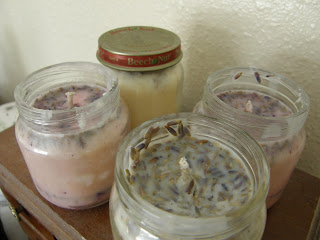
container candles with rosemary essential oil and a little cooking rosemary sprinkled on top.

I don't recommend using baby food jars as containers--I was using what I had, but they get very hot and the first one I burned melted all the way down, the wick floated out, and then it re-solidified... perhaps if I only burn it for 20 minutes at a time it will be fine, but not for an hour!

~~~~~~~~~~~~~
With pillars, you then have to get them out of the mold...I like using a mold that I can just cut/tear off, such as a rinsed out juice can or milk carton (quart size). Try pouring it in in layers--an inch of one color, an inch of another; or a little plain, a little with lavender flowers in it, a little more plain, etc. That will make some pretty striping.
Tallow happens to be very soft, and did NOT make good pillar candles. I ended up remelting these guys and making them into container candles. However this same method does make great candles with wax, so I kept the pictures since you're more likely to be working with wax anyway. ☺
one thing my mom likes to do is crush some ice cubes and put them in before pouring in the melted liquid...it makes cool tunnels in the candles, and also helps hold the wick in place.
see about the floating flowers?
this one was so soft--and so messy (due to the food color) that it was sticky, so I rolled it in lavender... which looked cool, but fell off everywhere when I handled the candle at all. Again, not a method I recommend!
they sure were pretty for our Imbolc feast though!
 ~~~~~~~~~~~~~
Finally, for dipped tapers, you will want to make sure that your tallow-melting-jar is tall and narrow. The height of your candles will be limited by the height of the jar, and width won't do you any good, it will just take more tallow to fill it... You don't want it too hot, but it does need to remain in a liquid state...so just keep the stove on a low setting.
The typical method is to cut a wick that is twice as long as your candle height (the depth of the jar) plus about 6 inches. Then hold it from the center and dip both ends to make a pair of candles. Before dipping, I twisted a bit of each end of the wick onto a paper clip, and then hooked the two paperclips together to make space between the candles. This proved to be the easiest way to keep the two candles to hang straight and not bump each other! (After they were all done, just take a knife and gently cut off the candle just above the paper clips.) I tried some without the paperclips and I definitely recommend using them!
Now they need to hang to dry. I just stuck a row of thumbtacks along the edge of the underside of my cupboard and hung them on that. If you have hanging mug hooks or something of that nature that would work well also. The candles will probably drip a bit (tallow definitely did, I don't know for certain about wax). In any case, I laid out paper towels on my counter underneath where I hung the candles.
You will need to dip them many times in order to get a decently fat (and sturdy) candle. I did find that the many thin layers of a dipped candle was much stronger than the poured pillars, and they work just fine with the tallow. I also found that--for tallow at least--you need to wait at least 10 minutes between each dip. If you do them too close together, the tallow on the wick does not harden enough and ends up just melting again with the dip, so the candle does not get any fatter!
This is a long process--I did it for a couple of hours one day (intermittently while I was baking something else), then a couple of hours the next day, then a couple of hours the next day...of course as a mother with little ones I get interrupted a lot, but honestly I think I would get bored if I stuck to it for the several straight hours it would require to do them in one go. The dipping is quick, but the waiting between sortof demands a second project to work on concurrently...
Can I just say, it is SO COOL to look at candles that I MADE!
I recommend storing them hanging (Besides, they look so cool!!) just trim the wicks when you're ready to use them. (It can be hard to make them the same size as standard pillars, so you may find that you don't have a candle holder of the appropriate size...in that case, just make a little salt dough and make some candle holders!!)
(Edited to add...  Now that I've had a chance to actually burn the tapers, I don't recommend making tallow tapers. They burn down really fast. My 6 inch taper lasted about 10 minutes before it was just a puddle... It seems that containers are the way to go if you want to make tallow candles. If you want a free-standing candle like a pillar or taper, try something a little stiffer, like wax!)
 

Linked Within

Related Posts Plugin for WordPress, Blogger...